



TAT: The Need For Speed
Richard D. Lippert, Jr.
Founder, President, and Chief Executive Auditor, Mammologix · Breast Imaging Operations since 1995
In March 2014, a movie adapted from the Electronic Arts video game, The Need for Speed, appeared in theaters. It's an action-packed story about a mechanic who becomes involved in an underground racing circuit's cross-country race.
In this article
Faster. Faster. Faster.
In March 2014, a movie adapted from the Electronic Arts video game, The Need for Speed, appeared in theaters. It's an action-packed story about a mechanic who becomes involved in an underground racing circuit's cross-country race. It took over 100 supercars to make the film, with some capable of topping 190 mph.
Now, that's fast! There's no doubt cars like that can quickly get you from point A to point B.
Defining an expectation of Turnaround Time (TAT) for breast imaging practices means they are also in a race involving speed. However, in this case, it measures up to a level of customer satisfaction by promptly accomplishing the steps involved in imaging.
A Point of Intrigue
An interesting thing about TAT is that while the concept seems simple - the test cycle time - the whole thing is rather complex.
The challenge with TAT is that this single term can mean different things to your practice's customers or stakeholders. The examinee having the mammogram has one set of expectations. The clinician ordering the procedure has another. The interpreting physician has a third. Additionally, other internal or external stakeholders to the practice may have very different expectations of their own about turnaround time.
Another interesting fact about TAT: More often than not, having a low median score (fast TAT) will most likely go unnoticed, while an excessive TAT will be lodged as some formal complaint.
What is the Anatomy of TAT?
In breast imaging, TAT is the period between an examinee having an exam and some other event.
The time from when a screening mammogram is interpreted as needing additional imaging until the examinee returns for the recommended diagnostic breast imaging follow-up procedures is a typical example of this type of TAT measurement.
When considering TAT involvement in breast imaging practices, you can use eight steps to determine benchmarking measurements: ordering, scheduling, registration, testing (imaging, biopsy), interpretation, reporting, dispatching (sending to EMR, printing reports, mailing letters, etc.), and finally, action.
Simply measuring the TAT between screening mammograms and recommended diagnostic imaging follow-up provides insight into only one element of your practice. While it is one, it is just that...one!
In addition, when considering TAT, it is essential to consider areas where your practice has direct control and those where you have little or none. These are referred to as intra-practice and extra-practice factors, respectively. Being aware of extra-practice factors impacting TAT can be enlightening. However, if you cannot alter them to bring about improvement, holding your practice accountable accomplishes very little to enhance turnaround time. Focus on intra-practice factors instead.
Faster = Better?
It seems reasonable to assume that the more timely and rapid your facility performs tests, the more efficient and effective your patient care can be. The overall outcome improves as TAT drops.
Indeed, faster TAT brings about the benefit of enduring a waiting period. Such a decrease could lead to a demonstrable reduction in anxiety or mental stress in obtaining test results.
According to the Robert W. Franz Cancer Research Center at Providence Portland Medical Center, "Like a lot of cancers, breast cancer grows by simple cell division…Breast cancer has to divide 30 times before it can be felt. Up to the 28th cell division, neither you nor your doctor can detect it by hand. With most breast cancers, each division takes one to two months, so by the time you can feel a cancerous lump, the cancer has been in your body for two to five years" (2022).
Meanwhile, turnaround times are measured in days for most breast imaging practices. As a result, the scientific literature seems to focus more on the timeliness of breast imaging to find undetected breast cancer through screening mammograms and diagnostic mammography as soon as a problem than differences in outcomes due to an improvement of a few days in TAT.
Indeed, this doesn't mean every breast imaging practice should not continually strive to reduce their TAT to as low as reasonably achievable within the construct of their organization and its intra- and extra-practice factors.
Improving TAT
Mammologix encourages all its clients to pay attention to crucial TAT measurements and offers tools to help them participate in programs like the National Quality Measures for Breast Centers®.
The NQMBC® is a voluntary quality program that identifies the quality of care measures, provides immediate access to quality information, and allows breast centers to compare their performance with other centers across the United States and beyond. Participants in the program can enter their quality measure data and compare their performance with other breast centers for the measures they submit data (National Consortium of Breast Centers, Inc.).
Looking to get started at your practice?
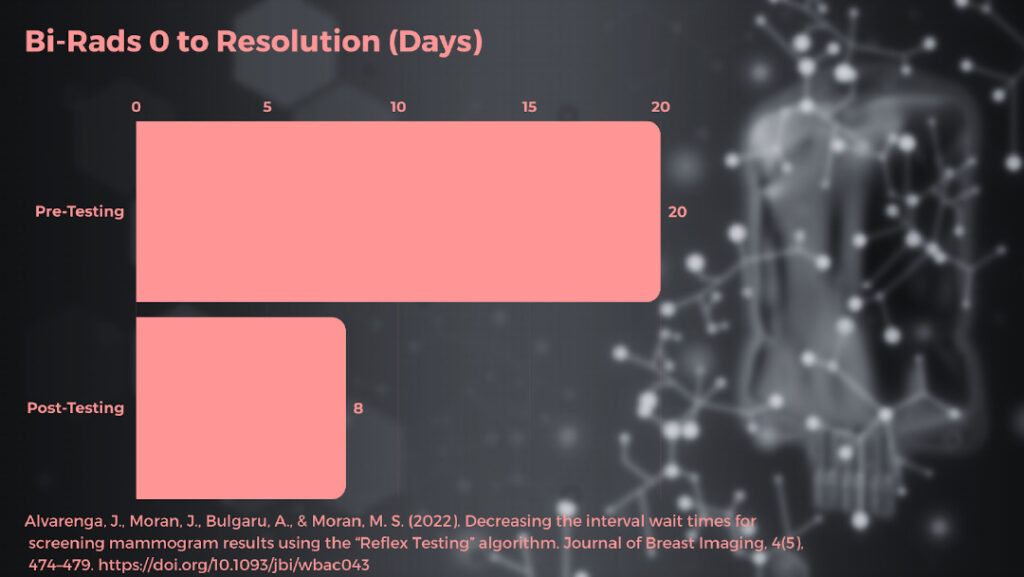
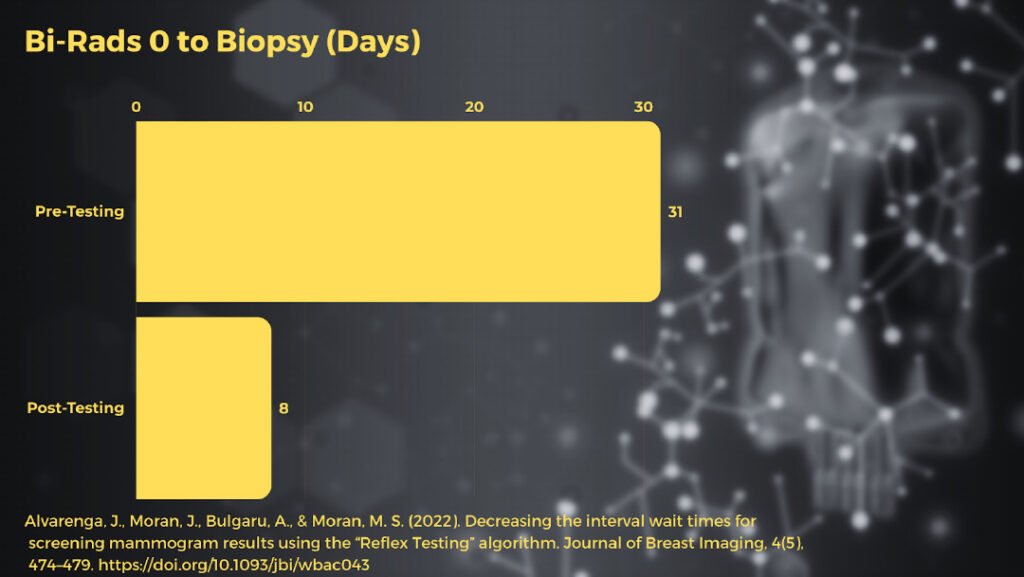
Below are the illustrated effects of improving TAT at a breast imaging facility before and after they began using "a patient navigator to facilitate callback scheduling and generation of automated diagnostic imaging and biopsy orders at the time each screening mammogram order is placed" (Alvarenga et al., 2022). This facility reduced their TAT between Bi-Rads 0 and the mammography resolution or biopsy. By doing this, they could better serve and focus on their patients and ensure that all of them had support during their breast imaging experience.
References
Alvarenga, J., Moran, J., Bulgaru, A., & Moran, M. S. (2022). Decreasing the interval wait times for screening mammogram results using the "Reflex Testing" algorithm. Journal of Breast Imaging, 4(5), 474 to 479. https://doi.org/10.1093/jbi/wbac043
National Consortium of Breast Centers, Inc. (n.d.). Quality Measures Program. NQMBC 2.0 National Quality Measures for Breast Centers. https://www.nqmbc.org/quality-measure-program/quality-measures.cms
Providence Health Team. (2022, October 13). Ask an expert: Breast cancer growth rate. Providence Family Wellness. https://blog.providence.org/women/ask-an-expert-breast-cancer-growth-rate
About the Author
Richard D. Lippert, Jr.
Founder, President, and Chief Executive Auditor, Mammologix · Breast Imaging Operations since 1995
Founder of Mammologix, Richard D. Lippert, Jr. has spent more than 30 years in breast imaging operations, from clinical practice and hospital radiology administration to building specialized service platforms for imaging centers nationwide. His work spans mammography tracking, lay communication, FDA/MQSA-related support, medical outcome audit, and the operational systems that help facilities stay compliant and keep patients from falling through the cracks.
Full credentials and background →Keep Reading
Related Resources
Why Volume Matters
The Importance of Using the Indicator of Volume in the Mammography Medical Outcome Audit Mammography plays a crucial role in detecting and diagnosing breast cancer.
As Compared to What?
One of the interesting observations we've made in dealing with hundreds of practices is while so much of what goes on at each breast imaging location is the same, there is also a broad array of differences.
I'm Here Because ...
3 Ways Examinees End Up at Your Practice for Their Mammogram. Getting an order from a physician is perhaps the most time-honored method for an individual to undergo a breast imaging procedure. A patient with a traditional patient-physician relationship initiates this process.
See how Mammologix puts this into practice
Real operational support for breast imaging centers.