



Scoring the Letter: Using the PEMAT on Mammography Lay Summaries
Richard D. Lippert, Jr.
Founder, President, and Chief Executive Auditor, Mammologix · Breast Imaging Operations since 1995
Federal rules require every certified mammography facility to send patients a lay-language results letter. Most facilities have never scored one against a validated instrument. The PEMAT is free, takes about 20 minutes per document, and returns two scores and a remediation list.
In this article
Every certified mammography facility sends patient letters. Federal rules require it. Each patient receives a written summary of her mammography report in lay terms [1]. Since September 10, 2024, that summary must also carry a breast density notification statement [2].
Most facilities have never scored one of those letters against a validated instrument. The letter goes out. The only feedback loop is a phone call from a patient who did not understand it.
There is a better instrument available, it is free, and it takes about 20 minutes per document.
What the PEMAT measures
The Patient Education Materials Assessment Tool (PEMAT) is a scoring instrument published by the Agency for Healthcare Research and Quality (AHRQ), which distributes it free with a full User's Guide [3]. The work was done under contract to AHRQ [3]. Sarah Shoemaker, Michael Wolf, and Cindy Brach published the validation study in Patient Education and Counseling in 2014 [4]. Four rounds of reliability testing preceded release, and the instrument demonstrates strong internal consistency and evidence of construct validity [3,4].
It measures two things, and only two things.
Understandability. Whether people of diverse backgrounds and varying levels of health literacy can process and explain the key messages [3].
Actionability. Whether those same readers can identify what they can do based on the information presented [3].
Two versions exist. The PEMAT-P scores printable materials across 24 items [5]. The PEMAT-A/V scores video and multimedia across 17 items, which covers waiting room loops and portal explainer videos. Lay summaries, results letters, preparation instructions, and navigation mailers are all printable materials, so the PEMAT-P governs.
How the scoring works, and the one trap
Each item receives Agree for one point, or Disagree for zero. Some items also allow Not Applicable. AHRQ scores the two domains separately and reports two numbers rather than combining them [5].
The formula is simple. Sum the points, divide by the number of items actually rated, and multiply by 100.
The trap sits in that denominator. Not Applicable does not score zero. It removes the item from the denominator entirely, which raises the score.
AHRQ gives a worked example. A material rated Agree on 12 understandability items, Disagree on three, and Not Applicable on one scores 12 divided by 15, or 80% [5]. The Not Applicable item never enters the arithmetic.
In our experience across roughly 200 client imaging facilities, this is where scores drift upward without anyone intending it. Every Not Applicable call has to be defensible, because each one makes the material look better. Record the reason.
One more rule governs everything else. Rate an item Agree only when the characteristic holds throughout the material, which AHRQ puts at 80% to 100% of the time [5]. If there are obvious places where the characteristic could have been met and was not, the rating is Disagree.
Why this applies squarely to the lay summary
The Mammography Quality Standards Act (MQSA) requires each facility to provide every patient a summary of the mammography report written in lay terms [1]. The regulation sets the standard. It does not define how to measure whether a given letter meets it.
The PEMAT is that measurement.
The 2023 MQSA Final Rule raised the stakes [6]. The US Food and Drug Administration (FDA) issued it on March 10, 2023 and began enforcing it on September 10, 2024 [2]. The lay summary must now carry the patient name, the facility name, address, and telephone number, and one of two prescribed breast density notification statements [2]. More required content in the same envelope means more competition for a reader who may only read the first block.
Where the regulation and the instrument collide
This is the part that surprises people, and it deserves a plain statement.
The prescribed density notification closes with a directive. It tells the patient to talk to her healthcare provider about breast density, risks, and her individual situation [2]. Under PEMAT item 22, a material must break any action into manageable, explicit steps, and terms open to interpretation do not qualify [7]. That closing directive is exactly the kind of broad instruction the instrument rates as Disagree.
A facility cannot fix that by rewriting the sentence. The wording is federally prescribed.
So the correct handling is threefold. Score the material as it stands. Record the constraint in the review notes. Then earn the item back in the content written around the required statement, by naming who to call, by when, and what to ask for.
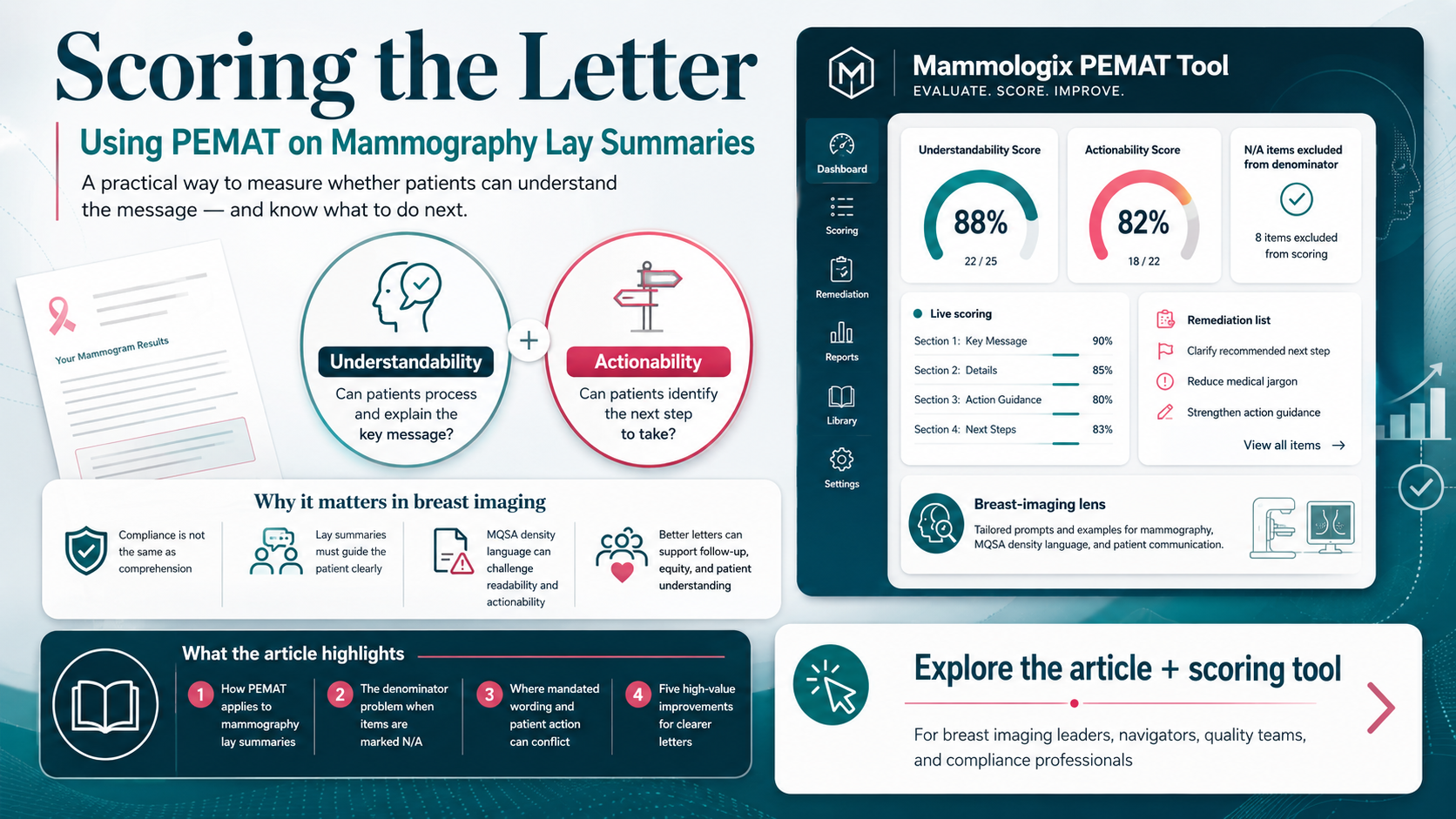
The Mammologix PEMAT Scoring Instrument
We built a free scoring tool on the Mammologix PEMAT Scoring Instrument because the alternatives are a paper form and a spreadsheet. Disclosure: the tool described below is a Mammologix product. It is free, it requires no account, and it implements the AHRQ instrument without modification.
The tool carries the full AHRQ item set verbatim for both versions. It scores both domains live as ratings are entered. The denominator assembles in real time, with Not Applicable items visibly dropping out. Results stay locked until every item is rated, because a partial review produces a misleading percentage.
Three features matter most for breast imaging work.
Item guidance drawn from the AHRQ User's Guide. Each item opens to show the rating rule, a passing example, a failing example, and the AHRQ definition that governs any Not Applicable call. The underlying guidance for the actionability items sits in the AHRQ User's Guide [7]. A reviewer never has to guess what very short material means.
A breast imaging lens. Each item carries a note applying the criterion to mammography materials. A further 10 items carry MQSA context sourced to the FDA and 21 CFR 900.12. The lens can be switched off to score against the unmodified instrument, and every export records whether it was active.
A remediation list rather than a number. The results panel returns every item rated Disagree, paired with the specific fix, plus an exclusion audit listing every Not Applicable call for defense.
What to look for
Five items account for most of the recoverable points in mammography letters.
- Item 1, purpose evident. A patient should know from the opening line what the letter tells her. A subject line naming a category is not a purpose.
- Item 11, summary. A short block carrying the result, the next step, and the phone number is the least expensive point on the instrument.
- Item 21, direct address. Institutional voice fails this item. Speak to the reader as you.
- Item 22, explicit steps. Name the number, the deadline, and the exam to request.
- Item 23, tangible tool. A tear-off card with the appointment date, location, and preparation instructions converts a letter into an aid.
One scheduling note belongs here. Score the letter before its template is locked into the reporting system, not after. Template edits made downstream of an information technology build cost far more than the same edits made in a draft.
The advantages of scoring this way
Scoring produces a number, and a number does four things prose review cannot.
It makes revision arguable. A writer and a compliance officer disagreeing about a letter are trading opinions until an item number and a criterion enter the conversation.
It makes the work auditable. A dated review record naming the reviewer, the ratings, and the exclusions is documentation, and documentation is how quality programs defend decisions later.
It makes patterns visible. One review describes one letter, and twenty reviews across a service line show where communication breaks systematically. Published PEMAT studies suggest the break is more often actionability than understandability. One analysis of 186 online materials scored understandability at 61.5% and actionability at 38.7% [8].
It makes improvement cheap. Most of the recoverable points sit in structure and phrasing rather than in content, so the fixes cost editing time instead of clinical review.
What the PEMAT will not do
Two limits deserve equal billing with the advantages.
The instrument does not assess clinical accuracy, comprehensiveness, or readability [3]. It also says nothing about whether the content is current. A material can score 100% and still be wrong. AHRQ recommends pairing the PEMAT with a readability assessment, and cautions that a readability formula alone is not a substitute [3].
A high score also does not guarantee the material works with a given patient population. AHRQ recommends testing materials with actual patients [3]. Scoring is a screen, not a substitute for asking women whether the letter made sense.
Two further points are worth stating plainly. The PEMAT is not an MQSA requirement, and a PEMAT score carries no regulatory weight in an FDA inspection.
AHRQ publishes no passing score [3]. The 70% adequacy threshold common in the literature traces to the instrument's original validation work, and later studies carried it forward [8]. That makes it a convention rather than a standard.
What to do next
Pull the three letters your facility sends most often. Score each one on the PEMAT-P, one reviewer at a time, using the tool or the AHRQ auto-scoring form.
If two people will score, run the AHRQ calibration process first. Both raters score the same two materials independently, compare the items where they disagreed, and return to the User's Guide until agreement holds [3].
Then fix the Disagree items in order, rescore, and file both records.
References
Quality standards: communication of mammography results to patients. 21 CFR §900.12(c)(2) (2024). Facility responsibility to self-referred patients is at §900.12(c)(2)(ii). Accessed July 27, 2026. https://www.ecfr.gov/current/title-21/chapter-I/subchapter-I/part-900/subpart-B/section-900.12
US Food and Drug Administration. Important information: final rule to amend the Mammography Quality Standards Act (MQSA). Updated September 10, 2024. Accessed July 27, 2026. https://www.fda.gov/radiation-emitting-products/mammography-quality-standards-act-mqsa-and-mqsa-program/important-information-final-rule-amend-mammography-quality-standards-act-mqsa
Agency for Healthcare Research and Quality. The Patient Education Materials Assessment Tool (PEMAT) and User's Guide: introduction. Reviewed November 2020. Accessed July 27, 2026. https://www.ahrq.gov/health-literacy/patient-education/pemat1.html
Shoemaker SJ, Wolf MS, Brach C. Development of the Patient Education Materials Assessment Tool (PEMAT): a new measure of understandability and actionability for print and audiovisual patient information. Patient Educ Couns. 2014;96(3):395-403. doi:10.1016/j.pec.2014.05.027
Agency for Healthcare Research and Quality. PEMAT for printable materials (PEMAT-P). Reviewed November 2020. Accessed July 27, 2026. https://www.ahrq.gov/health-literacy/patient-education/pemat-p.html
Food and Drug Administration, HHS. Mammography Quality Standards Act; final rule. Fed Regist. March 10, 2023. Accessed July 27, 2026. https://www.federalregister.gov/documents/2023/03/10/2023-04550/mammography-quality-standards-act
Agency for Healthcare Research and Quality. The Patient Education Materials Assessment Tool (PEMAT) and User's Guide: domain, actionability. Reviewed November 2020. Accessed July 27, 2026. https://www.ahrq.gov/health-literacy/patient-education/pemat9.html
Furukawa E, Okuhara T, Okada H, Nishiie Y, Kiuchi T. Evaluating the understandability and actionability of online CKD educational materials. Clin Exp Nephrol. 2024;28(1):31-39. doi:10.1007/s10157-023-02401-6
About the Author
Richard D. Lippert, Jr.
Founder, President, and Chief Executive Auditor, Mammologix · Breast Imaging Operations since 1995
Founder of Mammologix, Richard D. Lippert, Jr. has spent more than 30 years in breast imaging operations, from clinical practice and hospital radiology administration to building specialized service platforms for imaging centers nationwide. His work spans mammography tracking, lay communication, FDA/MQSA-related support, medical outcome audit, and the operational systems that help facilities stay compliant and keep patients from falling through the cracks.
Full credentials and background →Keep Reading
Related Resources
What Is a Lay Result Letter in Mammography?
The Mammography Quality Standards Act requires every certified facility to send each patient a plain-language results letter within 30 calendar days -- or within 7 days when findings are Suspicious or Highly Suggestive of Malignancy. The 2023 Final Rule, effective September 10, 2024, added mandatory breast density classification and exact FDA-prescribed notification language that facilities may not alter. This article covers what the letter must contain, how it differs from the technical report, and the evidence-based design principles that determine whether patients act on their results.
Time For A Wellness Check?
Benefits of Recreating and Reframing Result Lay Letters. Have you given any consideration lately to letters used for communicating with examinees and whether they comply with requirements for notifying mammogram results to them?
Two Words in a Results Letter Tell Patients the Opposite of What You Mean
Positive and negative are clear to a radiologist and backwards to the woman reading them at her kitchen table. Here is what the research shows, and the plain words that work better in the patient summary.
Two words breast imaging results letters reach for first , positive and negative , mean the opposite to most patients of what they mean clinically. Here is what the evidence shows and what plain language looks like instead.
See how Mammologix puts this into practice
Real operational support for breast imaging centers.